

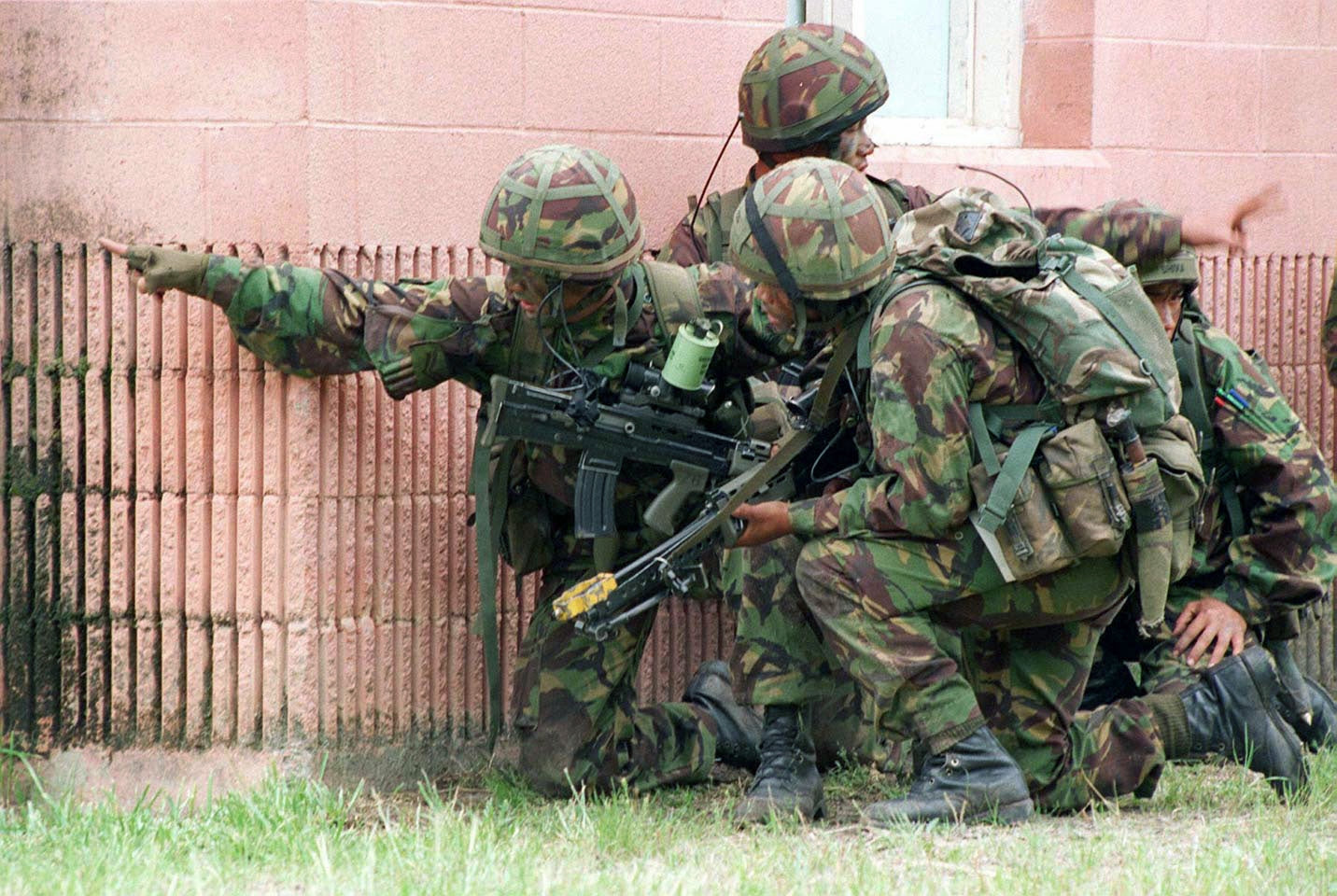
In one way or another, mass-production of printed textiles changed the way militaries are uniformed, but before that, we had to break out the paintbrush...
Camouflage in most regards prior to World War I was a tool for snipers, hunters, and all kinds of other sneaky operations. But when machine guns & heavy artillery confined war to the trenches, something changed. Uniforms darkened from bright colors and feather'd hats to match their landscape a lot more, outside of ceremonial garb and the odd flamboyant German Pickelhaube.
Mechanization of warfare also meant the mechanization of production lines, and a re-thinking of uniforms by just about everyone. Textiles were advancing in complexity and durability at lightning pace, and everyone seemed to start opting for more neutral colors that blended into the landscape like greys & greens. A few experiments in camouflage, mainly on metallic surfaces like helmets & vehicles also came about, and so would specially painted over-suits & tarps for snipers. But nothing would be quite as major as what would come next...

Once World War II was fully in gear, a few nations independently started colorizing their uniforms more as the stakes rose in the European theater. A couple of the most prolific camouflage pattern trends would all start as D-day dawned, literally. Nazi Germany would be experimenting with a few patterns for their Super Special units that would eventually mature into US Woodland, Swedish Splinter, & even Flecktarn with much earned controversy along the way. But as midnight on D-Day arrived, SAS troops would be parachuting in wearing something quite different — "brushstroke" smocks.
These "Denison Smocks" were the culmination of everything you'd want as a paratrooper. A versatile, mobile garment with tons of storage that doesn't get in the way of your kit, and keeps you warm on a cold evening in the skies over Northern France.

The fabric was the result of earlier (1941-1942) experiments with literal brushstroke camouflage patterns painted on with non-colorfast dyes to break up the shape of troops.
The printed pattern proved to be just enough to allow them to slink by German defenses and complete one of the highest-stakes missions in the entire Allied campaign to sabotage German logistics & comms before the massive landing in Normandy.

Another look at the pattern, allegedly taken in Bermuda. You can see how it literally looks like it was painted on.
In some ways, this was the birth of both "brushstroke" patterns, and the grandfather to "disruptive pattern material" or DPM, known for its instantly recognizable and rather painterly brushstrokes. Even though the original was hand painted, the pattern would stay rather painterly for the rest of its lineage, even up to today.
DPM woodland as we see it on surplus would drop some of the brushstroke-yness for more solidly colored blobs in the mid 1960s, when many nations began to standardize what would be their cold-war classic patterns. For decades, this pattern would go largely unchanged outside of some smaller details. In fact they were so stubborn to use anything else that even when Operation Desert Shield was in full swing, the MOD reportedly "Scrambled" to put together a tan variant, Desert DPM, to match the sandbox NATO begun to play in.

As the sandbox wars continued, however, the shortcomings of Both DPM and Desert DPM shone. As we've spoken about in our article about the "Green Zone", troops even resorted to field-dyeing their desert garments or wearing woodland to better fit in with the mountainous environments of Afghanistan.
Multicam would take many special forces and eventually entire militaries by storm, but the British are really bad at letting old things go, so after some camo trials, they took the coloration of Multicam and applied it to some of their ole reliable DPM patterns, resulting in "Multi Terrain Pattern" or MTP.
So close to multicam you can practically mix it, but we'll let the MOD and Crye settle it in court if they have to.

None of these anecdotes speak to just how widespread DPM really became - every "commonwealth" country and a handful of extras adopted some form of this pattern. Like US M81 woodland, it is an unshakeable worldwide phenomenon with humble roots in WWI and WWII. Whether in the midst of the South African border war or worn by members of terror cells & the IRA, to its frequent appearance in "Punk" fashion, DPM still rears its head in just about as many places as US M81 woodland.

Yes, that's none other than Richard D. James (Aphex Twin) wearing what would appear to be surplus Desert DPM pants.
Depending on where in the world you come from, It's what pops into your head when you think of the word "Camouflage", and that's the kind of nearly-100-year legacy that can truly only be made by brave men leaping into the darkness on a near-suicide mission that would determine the fate of geopolitics for a century...
Share:
This Isn't Green: Austrian RAL 7013