

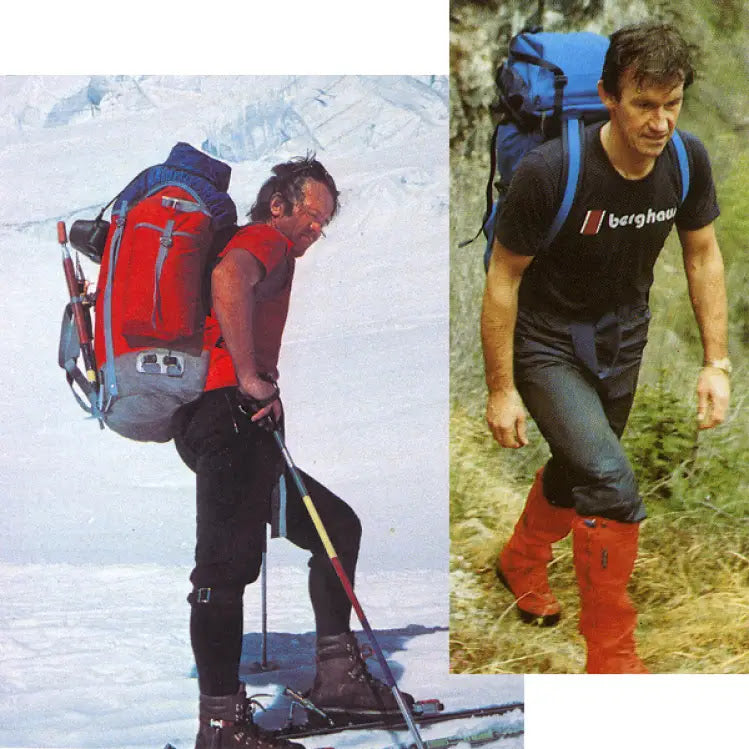
When we sat down to do our homework on truckloads of Berghaus bags we couldn't help but be totally hooked on not just their extensive features, but a backstory we can really relate to — from importers to manufacturers, Berghaus is now permanently cemented as one of the greats of the outdoor industry.
The origin is quintessentially just like ours. Two gentlemen named Peter Lockey & Gordon Davidson opened LD Mountain Centre ("LD" from their surnames) in 1966. Their main business was importing quality gear for aspiring outdoorsmen from all over Europe, mainly Germany and Austria.
But we can speak from experience - you catch a bug when you handle that much cool gear from over there. You want to start making your own. Davidson was an engineer by trade and a serious mountaineer by instinct. Inevitably, the first Berghaus branded items appeared in their shop in the 70s, with "Berghaus" being an abstract German Translation of their shop's name, "Mountain Centre". Lockey-Davidson just doesn't have the same ring to it. It sounds like someone who makes terrible biplanes.
Innovations came as quickly as the outdoor industry really started to mature. In '72, their "cyclops" internal frame rucksack made its debut as one of the very first of its kind. As Gore-Tex made its debut, it appeared as soon as it could on products proudly embroidered with the Berghaus name.
Shortly after, their magnum opus, the crusader pack, began to take shape. That "cyclops" internal frame system got them thinking BIGGER. The crusader instantly became known as the king of large, internal frame packs as their flagship product. It was miles ahead of what just about any military was doing, which instantly got their attention. No secondary bag required.
The key aspect was it's "system thinking". The detachable side pouches on the pack, each about 10 liters, could be unzipped from the main body and connected to each other to form an independent patrol pack. A genius invention and gave soldiers unparalleled versatility. A full 90-liter system for long range patrols or a stripped-down daypack load for when the misison dictated it.
It first shone in the British Falklands campaign, where soldiers from elite commando units went out of their way to buy their own packs to replace the mediocre issued kit (which, is worth an article on it's own. Several brands you know today got their start during this incident). The Berghaus crusader was available off the shelf in olive green and fit their load needs perfectly.
It's pseudo-trials during the Falkland's campaign were a massive success. The waterlogged muddy island punished standard kit in ways the MoD wasn't ready for. The Berghaus bags tanked all the way through and made it home to tell the tale - and a rousing tale it was, as the Berghaus bags & Karrimor rucksacks began to be purchased directly by the British Army.
The British Army's PLCE system "Bergen", the standard issue rucksack for the UK which saw use for decades afterward, are effectively a clone of the "Vulcan" and "Crusader" packs that dunked on the previous system's shortcomings.
But that's one isolated example. The Crusader and Berghaus-inspired bags became either standard or semi-standard issue all over NATO countries. the Netherlands, Belgium, France, Germany, Luxembourg, Norway, and even all the way in Australia, the design kicked every other competitor to the curb. This wasn't a convenience thing - soldiers didn't want to give up the crusader once they had their hands on it, and switching away from them became a bigger ask than simply upgrading it.
Through the years, it saw the addition of MOLLE attachment points, bladder compatibility, and even more modular expansion systems across the lineup. But the core remains intact.
It's something we don't hesitate to say you can really buy for life, even when it's surplus — A 90s example will carry 80 pounds of gear without breaking a sweat. The YKK zippers will zip up and down the same way when you give it to your grandkid. The nylon doesn't delaminate. They were built to last, not to profit.
Some people might like the humble crusaders for the vintage aesthetic and ruggedness new gear often lacks — THICK materials. BIG buckles. Geometry that doesn't take a CAD-o-phile to explain.
And yet, Berghaus never "leaned into" the low-hanging buzzwords in their marketing. They're not "Military Grade". They're not even "trusted by special forces". They've always been about building things for the enthusiasts that got their brand off the ground in the first place, which is something even we aspire to.
Please the people, not the military contracts — we think that's a legacy worth carrying.
Share:
Disruptive Painted Material: British Camo from its Painterly roots
The Chernobyl Three — A tale of heroism straight out of STALKER