

Sweden's Armed Neutrality
Throughout the Cold War, Sweden maintained a policy of armed, aggressive neutrality. Unlike Switzerland (which relied primarily on being accessible and absolutely STACKED with military equipment from Western nations) Sweden took a self-sufficient approach to defense much like Austria, being in a crucial corridor for possible soviet invasion of western Europe.
Sweden played the geography game. In the vast northern territories, Sweden deployed mobile armored mechanized forces capable of rapid force projection. In the more populous and vulnerable south, they implemented defense-in-depth based on integrated mechanized ground forces, amphibious infantry, naval forces, and extensive coastal fortifications. In other words: pounce from the trees in the middle of nowhere and dig in deep around your cities.
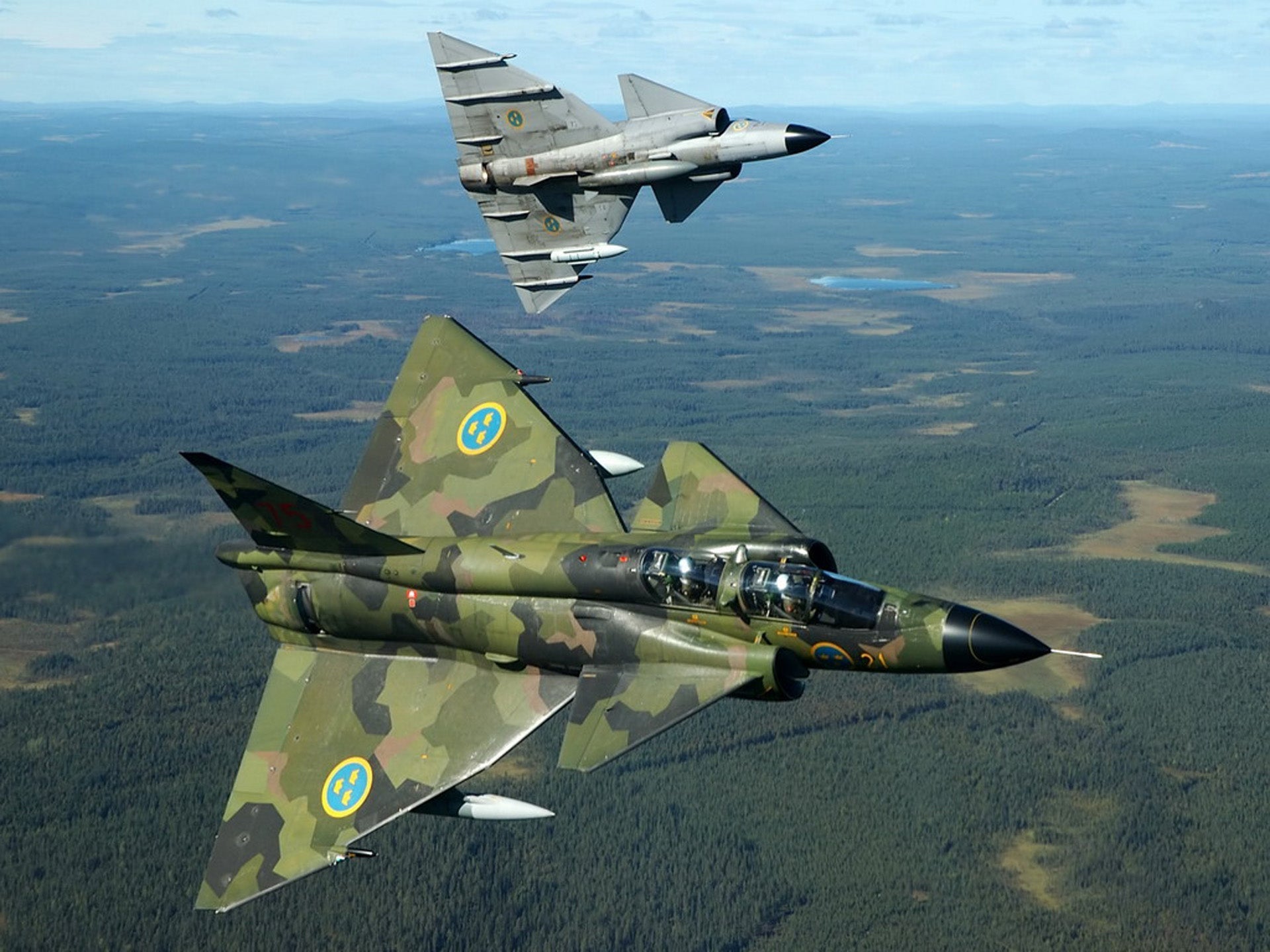
Supporting all this was the Swedish Air Force. At its Cold War peak, it was the fourth-largest air force in the world, with over 1,000 aircraft, including loads of armed fighters. The eastern coast of Sweden, stretching a couple thousand miles, featured what was arguably the world's most powerful coastal defense system: ninety heavy cannons with underground facilities, numerous bunkers and pillboxes, submarines, and coordinated air support.

To hide a vehicle: the camouflage problem
Sweden's defensive doctrine presented a unique challenge. If war came with the Soviet Union, Swedish jets couldn't remain on peacetime airbases because they'd be immediate, priority targets. Instead, doctrine called for dispersing aircraft across small rural landing strips and pre-positioned depots where mobile teams could service them. Blink, and you'd miss them driving on some of Sweden's backroads.
This required camouflage designed for hiding aircraft and vehicles in forested locations against aerial and satellite reconnaissance.
In the 1960s, the Swedish government decided to develop a domestic camouflage pattern rather than copying another nation's design. This decision ensured maximum effectiveness in Swedish terrain and bolstered national pride in fielding a distinctly Swedish military force.
Development work fell to FOA (Försvarets forskningsanstalt), the Swedish Defense Research Institute. Through the 1970s, FOA scientists conducted extensive testing and experimentation, including aerial photography missions and field trials. The resulting pattern became colloquially known as “FOA camouflage.”
The pattern first appeared on Swedish military vehicles in the 1970s, then on aircraft (most famously the AJ-37 Viggen fighter, leading to the nickname “Viggenkamouflage”).

Sixty Six To One
Here's where it gets interesting: Sweden retained solid-colored field uniforms. Dark olive green M59 for summer, all-grey M58 for winter. Swedish infantry wore the same single-color uniforms from the 1950s through most of the 1980s, even as their vehicles and aircraft wore sophisticated camouflage patterns.
Only in the 1980s did the Swedish military decide to adapt the vehicle camouflage for personal uniforms. This presented a problem: the FOA pattern was designed to conceal large objects from aerial observation. It needed to work at entirely different scales and against different detection methods.
FOA scientists were called back to solve this. They scaled down the pattern by a factor of 1:66 to fit the entire design onto a human torso, while slightly redesigning it to work against the naked eye and binoculars rather than aerial photography.
The result was M90, a pattern with unusually large, geometric "splinter" shapes compared to other camouflage designs.

1-K Engagements
According to Hans Kariis, an expert at FOI (FOA's successor organization): "If you look at American or German patterns, they're very small. This has to do with the M90 pattern being adapted to the type of combat envisioned at the time. Our pattern works pretty well in forest and mixed terrain, where distances are at a scale of about one kilometer. The Americans are thinking about urban combat, in a city where distances are 10 to 100 meters."
This reveals Swedish defensive doctrine: expect to engage Soviet forces at long range across Sweden's temperate forests and open terrain. The M90 pattern uses hard-edged geometric shapes in four colors: dark green, medium green, dark navy blue (chosen because natural shadows appear blue to the human eye), and beige/khaki background. This disrupts the human silhouette at longer distances.

Deployment and Legacy
M90 entered service in the late 1980s, with troops wearing it by 1989. The uniform system was designated Fältuniform 90 (Field Uniform 90), or FU90. Full adoption across all Swedish forces occurred throughout the 1990s, completing by the early 2000s.
Swedish soldiers nicknamed the pattern “Lövhögen” (the leaf pile), and it became something of a national symbol. The pattern was so distinctly Swedish that it served both military and cultural purposes, instantly identifying Swedish forces while reinforcing national identity.
M90 would go on to serve in all kinds of international peacekeeping operations and combat missions. Swedish forces wore it in Afghanistan with ISAF, Mali, and many other places that necessitated new versions of M90 to be created:
M90K (Ökenkamouflage): Desert variant in warm greys, beige, and browns for Afghanistan operations
M90TR (Tropik): Rainforest variant with thinner fabric and subdued colors
M90TR BE (Tropik Beige): Desert variant similar to M90TR but in desert colors, including a smock for cold desert nights
M90L (Lätt/Light): Lighter fabric version for domestic summer use
Only in 2016 did Swedish special forces finally cave to the Multicam Menace, solely for interoperability with NATO forces. But M90's still kicking and still timeless.
Even three decades down the line experts agree it's still exceptionally effective. For a country with a very specific bill for defensive strategy, it fits the bill perfectly. In mixed terrain and a gargantuan forest cover in their nation, its design philosophy remains relevant to this day.
Share:
Cowboy to Commando: A Short History of the Bandolier
This Isn't Green: Austrian RAL 7013